
Why AI in E-Commerce Matters
Exponential Growth
The global e-commerce market is valued at $7.4 trillion in 2025, entirely driven by mobile commerce, international transactions, and the fast adoption of digital payments across developing markets. This growth increases an evolutionary change in consumer behaviour, specifically in product discovery, evaluation, and acquisition changes that are taking place more rapidly than ever before.
Business Challenges
With growing competition online, Companies have to cater to millions of customers with personalized offerings, keep their supply chains streamlined, and create loyal customers at no switch cost. Even well-funded retailers struggle to meet these demands consistently without the right tools.
AI Transformation
Market Growth
$6.9 Trillion
Strategic Challenges
Companies face challenges in achieving personalization on a large scale, managing inventory in a complex way, and maintaining a customer base over time. Providing customized solutions for a mass audience, optimizing stock levels, and establishing an emotional connection between a company and consumers in today’s competitive environment are problems that existing analytical solutions are unable to solve effectively enough.
Core Benefit
Actionable Insights
What is AI in Business Analysis?
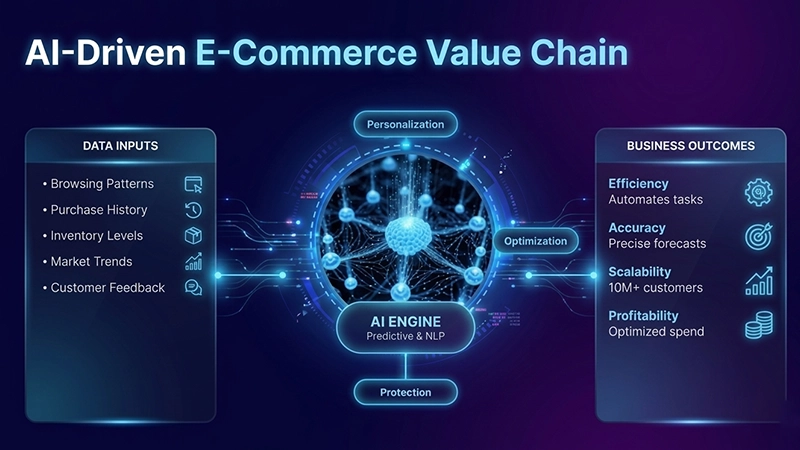
AI can be defined as the application of machine learning systems, algorithms for analyzing big data sets, and automation techniques to improve decision-making. In an e-commerce environment, all these aspects interact to process different kinds of data, including user behavior and logistics information, and make informed decisions.
Predictive Analytics
It is using historical data to forecast future trends, sales volumes, and market shifts with high precision. For example, a business organization may be able to predict an increase in demand during certain seasons of the year, thereby making sure that they have enough stock without investing unnecessarily.
NLP for Interactions
The Natural Language Processing technique is utilized in developing intelligent chatbots and sentiment analysis applications. An NLP-powered chatbot can handle numerous customer support requests at once, solve their problems immediately, and even recognize when customers are angry and intervene before the problem turns into something bigger.
Automated Inventory
Core Applications of AI in E-Commerce
Personalized Recommendations
- Customised recommendations based on history
- Improve customer experience and increase conversions
Dynamic Pricing Optimization
- Real-time adjustments
- Based on demand, seasonality, & competitors
Inventory Management
- Predictive sales analysis
- Prevents overstocking or stockouts
Customer Sentiment Analysis
- AI chatbots & feedback tools
- Drives brand loyalty & retention
The Future of AI in E-Commerce
Sustainable AI Ecosystems
AI-driven sustainability in the supply chain minimizes waste and carbon emissions by using hyper-efficient route planning and demand prediction. By determining the precise amount of inventory required and the most efficient routes for final delivery, e-commerce companies can minimize their environmental impact and save costs—showing that profit and sustainability go hand in hand.
Immersive Meta-Commerce
By integrating AR, VR, and AI together, organizations will be able to completely rethink the manner in which they design, demonstrate, and sell their products through digital platforms. Rather than using conventional catalogs, companies will be able to create immersive visualizations of the products, virtual showrooms, and AI-powered configurations that help customers better understand the products and services on offer.
Meta-commerce will allow enterprises to shorten their sales cycle and provide better experiences for buyers and differentiate themselves from others.