
📢 TVS Next partners with Snowflake to redefine Data and AI outcomes.

Category Archive

Modernization

Five Steps to Modernize Your Data Using Azure

microsoft azure

Data modernization with Microsoft Azure

In recent years, it’s become evident that the modernization of data and cloud migration is essential to the survival of businesses. Microsoft azure It’s not to say that legacy systems have to fall by the wayside altogether. Still, it’s crucial to establish a new way to distribute and provide access to company data for both your customers and employees/teams.

Companies that provide on-premises software will best understand the need to modernize existing applications and how it’s necessary when moving to a SaaS model. Updating your environment as a whole can help you make a move more flexibly and efficiently.

What is Microsoft Azure?

Modernizing data is essential to moving to a SaaS model, but it’s one of the first steps you should take in the migration. Other than improving communications between teams and automating redundant business functions, the whole point of modernizing and moving to a cloud platform is to enhance the user experience for your customers greatly.

Microsoft Azure is cloud engineering that continues to make the process of switching to the cloud easier for businesses across the board. Azure is a multi-cloud platform designed to help companies manage data applications. Microsoft Azure can store your data and transform it, depending on how you utilize the services.

Essentially a massive collection of networking hardware and servers tasked with running complex distributed applications, Microsoft Azure is compelling because of the way its servers are orchestrated. Azure is fantastic in the way that you can successfully add cloud services to your existing technology and legacy systems, which can make change easier for some.

Suppose you don’t want to add cloud technology to your current systems. In that case, you can use Azure as a Saas service, entrusting them with all of your network and computing needs. You can start using Azure for free, making it incredibly appealing for companies across the board, ranging from start-ups to established corporations.

Knowing if You’re Ready to Move to SaaS

It doesn’t take long to use up resources when operating within the software business. Building usable software isn’t easy, and there is a fair share of distractions, ranging from troubleshooting customer issues to sales. The cycle is relatively nonstop, and you’ll probably find that you’re spending quite a bit of time just maintaining operations without leaving anything left to dedicate to modernizing your operating systems.

By pulling your technology into the future, you can streamline your operations and reduce the time spent on tedious and repetitive tasks. This provides the opportunity to broaden your customer base and deliver new data.

If your business is based on an on-premises approach, it’s time to take a look at what Microsoft Azure can do for you. Your application services likely expect plenty of requirements from your customers and clients.

From scalability to security, you have essential application components that you have to deliver on to build the solutions you desire. To support millions of users worldwide, you have to find a way to draw them in and impress them in new ways. This becomes near impossible when you’re operating on old legacy systems that no longer make sense to your business model.

In short, if you’re ready to go big with data modernization, eliminating repetition, and enhancing the customer experience, you’re ready to move to a SaaS platform. Microsoft Azure can help.

Choosing a Cloud Program that Works

There’s no question that customers today demand a flawless experience intricately interlaced with fantastic customer service and state-of-the-art technology. It has become increasingly more challenging to meet the demands of the public. Modernizing your data through an efficient cloud program can help, but where do you begin?

Knowing that you need to meet customer expectations but not having the technology to do so can put plenty of pressure on your development teams and operation as a whole. To choose the right cloud program for you and determine whether you can entrust the cloud with your current systems, you’ll have to ask yourself a few questions.

Avoid Downtime

The cloud program you choose should help you avoid downtime at all costs, whether planned or unplanned. You want to avoid poor interactions with customers at all costs. While systems are expected to go down now and then, is your platform of choice able to help you deal with that?

Unexpected Spikes

Will your cloud platform of choice be able to help you handle unexpected spikes in traffic? Most cloud platforms, Azure included, are set up to help avoid customer complaints regarding poor working performance. You need a platform that will not require you to pay for a large amount of storage that you might not need in the long run, and Microsoft Azure is very customizable.

Expansion

The cloud platform you work with should assist you in expanding to regions beyond your average reach. With modernization and growth, new business should come, and your new platform must assist in that expansion. Azure will also give you access to the legacy systems that you’ve come to know and depend on, which is comforting to business owners of all sizes.

Secure Data

Regardless of your business type, you have got to keep your customer data (as well as your own) as secure as possible. Your cloud platform should go above and beyond to ensure that your data stays clear of jeopardy and Microsoft Azure is well respected in terms of security.

Azure: A Deeply Trusted Cloud Platform

Microsoft Azure is a cloud platform that more than 90% of fortune 500 companies rely on to monitor, upgrade, and secure their data. Azure was constructed from a cloud-first standpoint, which means that the platform knows how to deliver exceptional value to your customers regardless of where you live in the world.

Azure gives business owners on a global scale the comfort of knowing they no longer have to worry about performance or capacity. The platform allows you to scale up and down whenever needed without jumping through various hoops and financial commitments.

Your development team can easily tailor Azure to your operational needs, alerting you to performance issues and configuring your applications to scale up and down on their own, according to demand. When you use Azure, your customers will have consistent app availability, as the platform uses built-in automatic patching and backup and security and monitoring.

Azure is available in more than 140 countries, allowing you to put your data where your clientele resides. Overall, the platform has become essential to helping various businesses see sustainable and substantial growth quickly. The availability of Microsoft Azure is unparalleled, and if you’re considering a data modernization (and you should be), it’s time to seriously look into your options with Azure.

The Importance of Modernization with Azure

Moving your data to a cloud platform with the capabilities of Azure is sure to streamline your business processes over time. Of course, the modernization of data takes time, and it’s crucial to maintain a line of open communication with your team. When substantial changes take place, communication is vital to avoid confusion.

Data modernization can take your company to the next level, skyrocketing you to levels of growth you may never see otherwise. Now is the time to take advantage of the fantastic possibilities Azure has to offer.

Keep Your Loyal Customers by Enhancing the Customer Journey Digitally

customer journey mapping

Customer Journey Mapping

There’s no doubt that a seamless customer experience creates a loyal and repeat customer using customer journey mapping. Digital transformations can completely alter your client journey and overall experience. 

Most businesses today are going through a digital transformation on some level, and it’s all with the purpose of refining how your customers can interact with your business. However, successful digital transformations aren’t easy to pull off without factual data and a knowledgeable development team.

Understanding the Customer Journey 

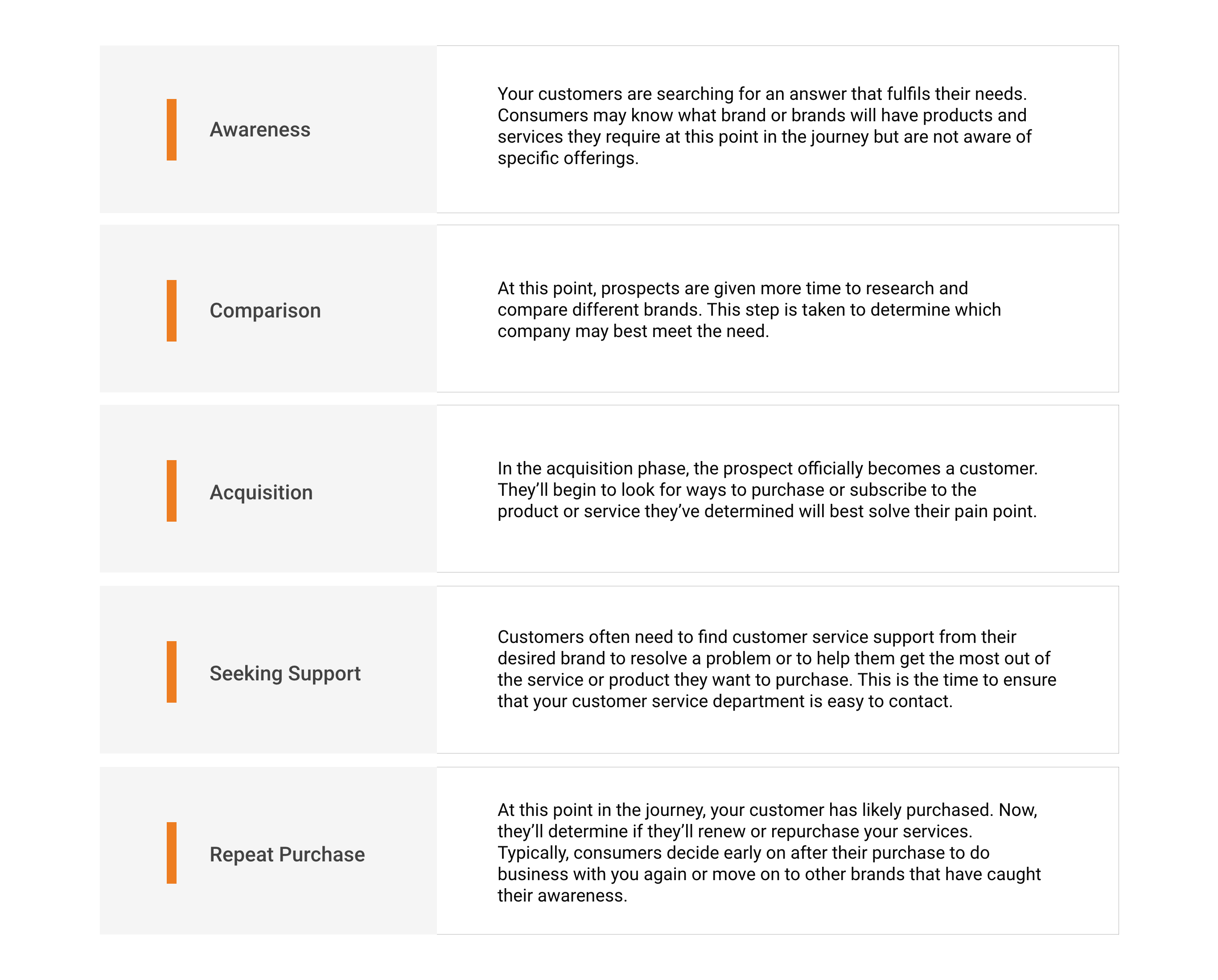
Before you begin your transformation expedition, it’s essential that you truly understand what the customer journey encompasses to stop losing customers to start-ups. In short, the stages of every customer journey, which differ according to persona and goals, follow the same general formula.

customer journey map

Mapping Your Customer Journey

When it comes time to begin mapping the customer journey, you’ll want to consider the specific stages (listed above) that your customer persona will go through. Next, brainstorm for your customer journey mapping session, and consider the following:

  • Define the profile of your consumer persona and define their goals
  • Set a clear objective for your map
  • List the customer touchpoints
  • Write out the elements that you’d like your map to showcase
  • Understand the resources you’ll need to solve customer pain points
  • Put yourself in the shoes of your potential customer
  • Make any changes necessary

Digital Transformation Improves the Customer Journey

Once you’ve established your customer persona and mapped out the journey, they’ll take with your brand. It’s time to put your plans into action. A company that has appropriately transformed digitally will have a much easier time at this stage than those that have not. Here’s a look at how to pull it off.

Transform Digitally While Continuing Operations

It’s impossible for you to successfully transform your systems while bringing operations to a screeching halt, even if your current systems don’t support an optimal customer journey. Your technology has evolved over the years, layered and stacked in stark comparison to cloud-based technology’s organized, sufficient container infrastructure.

Perceive the Customer Journey with a Modern Mindset

The customer journey map is still necessary, but it’s crucial to understand that, technically, the customer journey doesn’t end directly after the purchase. In most cases, post-purchase customer activities include sharing their opinion of your product and brand long after purchasing. 

It’s so essential to improve customer experience through digital transformation for this very reason. Word of mouth and online reviews carry a lot of weight regarding future potential clients’ decisions. 

Know Your Outcome

You can’t pull off a digital transformation without knowing precisely what you want from the change. If you’re unsure of what you want from your outcomes, you can generally focus on these aspects of enhancing your customers’ journey. The outcomes are a well-weighed balance of business, user and technology goals.

Security

Security comes before everything else. When you secure business and consumer data, you secure brand reputation. Your clients need to know that they can trust you, and adequate security measures are a massive part of digital modernization.

Speed

Speed is crucial to your digital transformation and your customer journey. You need to deliver content and your products and services at high speed with a very low risk, which is where security comes into play.

Analytics

Know your analytics and learn how to understand and analyze your data in real-time. Analytics help you know how your business is running and which marketing tactics are working and which are not. When you have instant access to such information, you can make the necessary changes right away.

Optimize IT Functions

Your digital transformation has to support your IT functions from end to end. However, it’s essential to keep your costs from getting too high. The cool part of optimizing your IT framework means you can look closely at which pieces of your business are working and which need integration.

Working with partners to digitally transform on an open scale can significantly help guide successful results. Your employees also need to be willing to change, probably continuously, as digital transformations occur. Optimizing functions throughout, and bringing in a third party to help, will make this process easier.

Stepping Back to Move Forward

Mapping the customer journey and transforming your company to serve the modern customer experience requires stepping back and looking at what isn’t working. Set your priorities and know your audience.

It’s crucial to review current processes to enhance your customer journey. If they do not, they should be reformed or eliminated. By moving forward on the right track, you’ll prevent losing your customers to start-ups that are already technologically advanced enough to provide outstanding customer service. 

The end game will always be the experience your customer has. Your customers drive your business, and the knowledge they have regarding your products and services has the potential to make or break you in the long run. Why not do everything you can to keep them coming back? It is the story of discovering and fulfilling the known needs better and giving the unmet needs life.

Level-Up Your Business Process with Microsoft Azure

cloud transformation

Cloud Transformation

There’s no question that cloud computing is on the rise, with more than 81% of companies running at least one application on cloud technology. The needs of any business are constantly changing, regardless of size or industry.

Microsoft Azure is cloud technology that has been a cornerstone in supporting those changes by processing large amounts of data and letting companies create dynamic and innovative ways of working. Without Microsoft Azure, many businesses would have been unable to work remotely throughout the peak of the pandemic.

Most larger-scale companies are successfully operating via cloud technology. While mid-size and smaller businesses are playing catch up, they’re struggling to harness the total value of what the cloud has to offer by moving applications without a complete digital transformation.

The Purpose of Cloud Transformation

Cloud technology is a big part of data modernization. When companies store something in the cloud, using developments like Microsoft Azure, they’re storing information on secure internet servers instead of computer hard drives.

The cloud is convenient, reliable and allows companies to expand their presence and workforce globally. When explained to those unfamiliar with the cloud, a great example is their email account.

Anyone who has utilized Gmail has used cloud technology, as all of that information is stored on internet servers instead of private computers. When you have to access your email, you can do it from any connected device, which means you do not have to be at home.

Cloud usage is skyrocketing because it provides businesses the means necessary to add to their remote teams and provide instant access to information employees need. There is no question that the cloud is vital to business modernization, notoriously making it easier to perform everyday company tasks such as:

File Storage

Companies can store various information using Microsoft Azure, from client files and employee email accounts.

File Sharing

Cloud-based services make it easy to share files with multiple people at one time. If you’ve ever used Google Documents or a photography website like Unsplash or Flickr, then you’ve taken part in file sharing on the cloud.

Data Backup

One of the most popular reasons companies begin to shift their applications to a cloud-based server is backing up crucial company data. Microsoft Azure can not only back up your files but provide ample protection for them as well.

As cloud transformation becomes more and more necessary, many companies are falling into the trap of moving IT systems to the cloud without executing the transformational strategy needed to harbor every app modernization aspect the cloud can provide.

Operating the cloud isn’t only about company connection and easy data storage. Instead, it’s about a complete and total company-wide digital conversion.

More than Moving a Legacy System to the Cloud

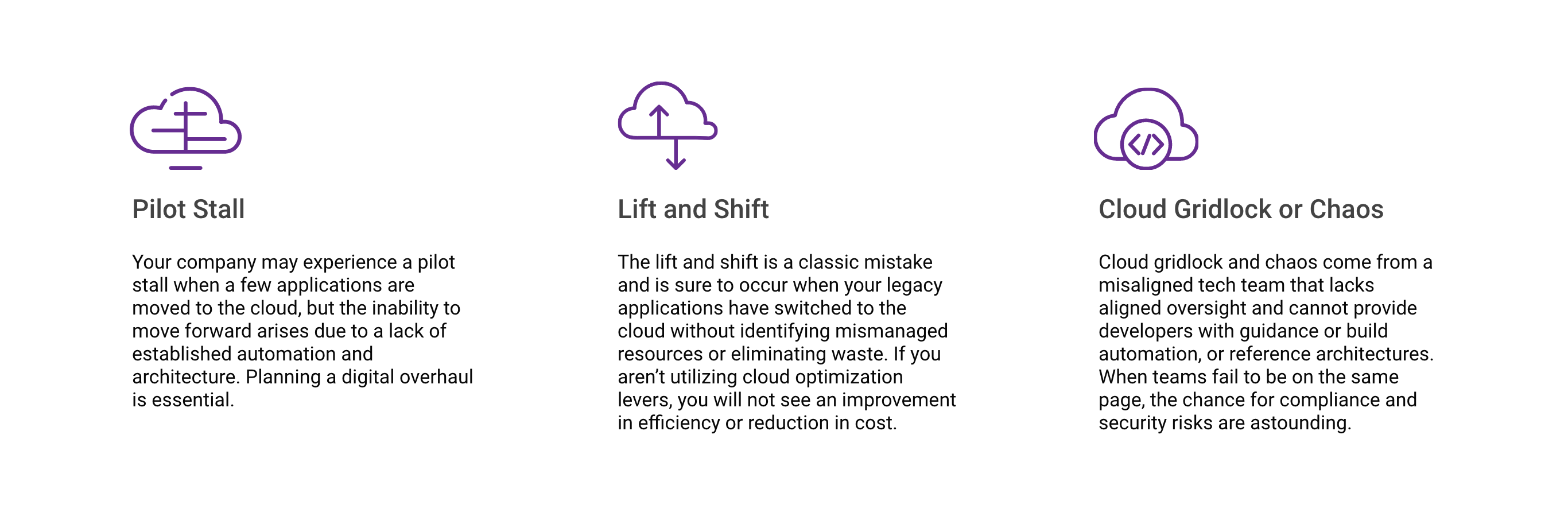
For many businesses, it seems only natural to move old and outdated systems to the cloud and call it a day. Unfortunately, this quick “lift and shift” makes for an overall ineffective usage of the cloud and may even make daily operations more complex.

Using the cloud is less about moving your legacy system and more about a complete and total legacy transformation. Yes, you need these systems because they are critical to the way you run your business, but instead of moving them, revitalize them.

The only way to get the most out of moving your current systems to the Microsoft Azure platform is to consider design deeply. Without the proper attention from a holistic viewpoint and embracing a complete digital transformation, companies place sensitive information on the cloud and face invasions from skilled attackers while lacking innovation and the agility needed to operate totally on the cloud.

So, what’s a company to do to successfully switch to Microsoft Azure?

Start with an Open API Model

Before you jump in and begin shifting your IT systems to a cloud server, step back and evaluate what this switch means to your company. It should represent so much more than easy access to applications and necessary files for your employees.

Successfully applying the use of cloud solutions requires a renovated company outlook. An open API model gives a way to standardize and automate your IT environment. Turning to the cloud to host your applications means adopting a modern security posture and working within an established yet agile operating model.

The cloud can seamlessly help you drive innovative business solutions and leverage new capabilities all-around. Still, before you implement, you have to take these new business stances and enforce them all around. You do not have to recondition your strategic outlook, but it is the only way to get the best performance possible from cloud-based solutions like Microsoft Azure.

When companies see cloud capabilities for what it truly is, the door opens to create a next-generation IT capable of enabling business growth and innovation within a rapidly evolving digital era.

Reaping the Most Value from Microsoft Azure

By now, we’ve established it’s no secret that some companies reap the full benefit of the cloud while others are creating a more complex operating system and wondering where they went wrong. The main difference is that companies that treat their employment of the cloud as a business-technology transformation were undeniably more successful than those that view the cloud as a quick fix.

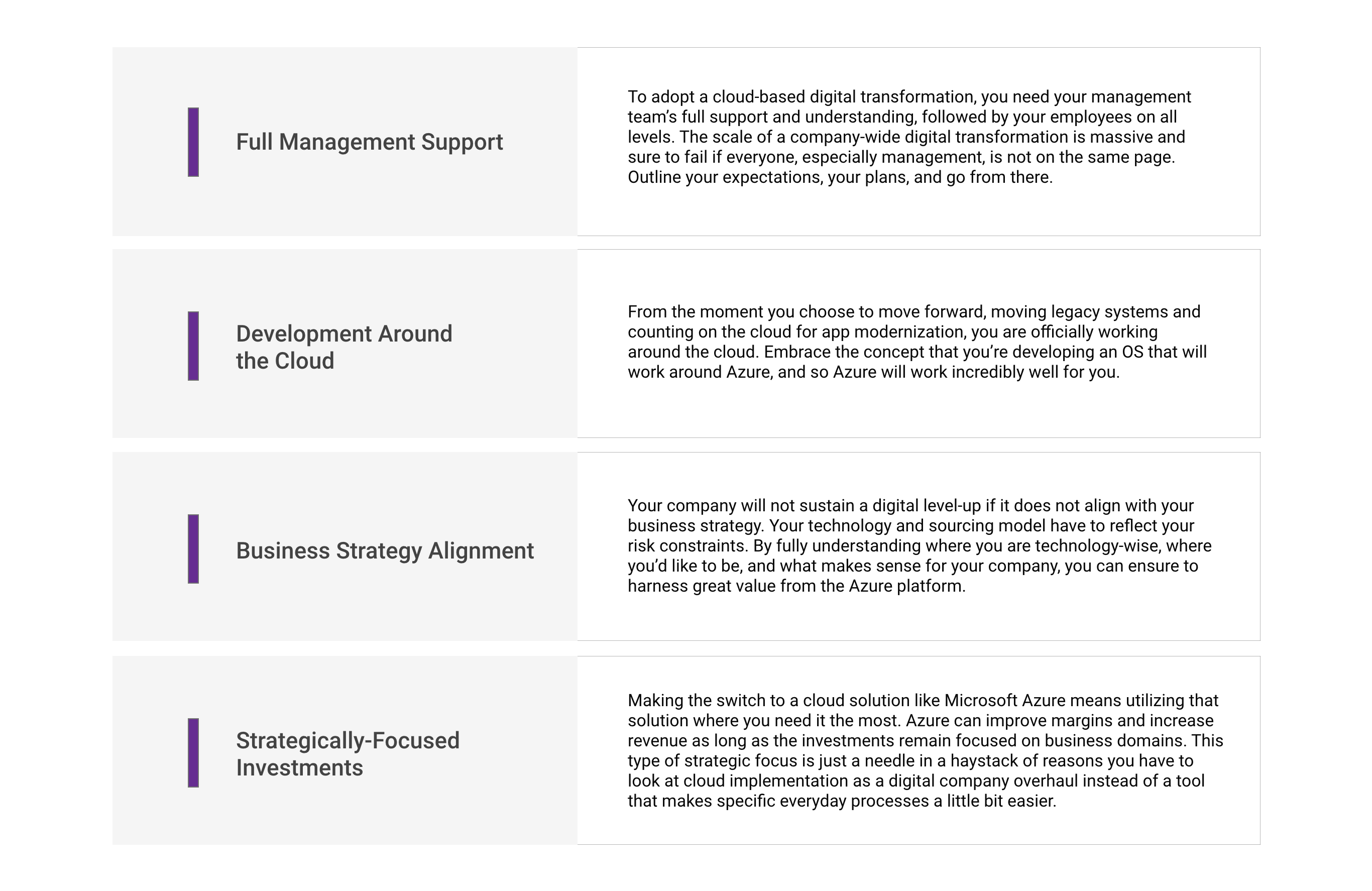
Your company can successfully gain every drop of value that Microsoft Azure offers, including networking, analytics, and storage capabilities. Before you begin your Azure transformation, you’ll want to ensure that your focus is in the right place.

Cloud Transformation Azure

The Complexity of Digital Transformation

Digital transformation is not easy, and if it were, every small to large scale company across the globe would employ it overnight. The sheer volume of work that it takes to enforce digital transformation is staggering and involves significant changes in company economics, processes, and skills, along with organizational modifications.

So often, a digital transformation fails, even with an incredible tool like Azure, simply because the infrastructure change is seemingly impossible to manage. Before you throw in the towel, school yourself on the most common failures of attempted cloud transformation, and take the necessary steps to stop them.

Complexity of Digital Transformation

Avoid Transformation Chaos with Azure

A digital transformation is often complex. Ancient organizational structures, authoritarian leadership, and inefficient workflows can hinder a successful digital transformation, but these are also reasons to enforce one. In 2020, companies of all sizes struggled to convert to a remote-based model, and for the most part, lack of time to plan and the inability to accept change were the culprits.

Digital transformation isn’t something that should happen overnight. This change is a massive undertaking and requires careful planning and the construction of a whole new way of working and communicating.

Azure is a fantastic choice digitally, as it provides a broad range of hybrid connections and plenty of security and reliability. With more data centers and delivery points than any other cloud service, Azure is the perfect foundation for your digital transformation rebuild.

Why the Future of Digital Transformation Lies in Human-Centered Automation

digital transformation

Digital Transformation

Digital transformation is an ever-present entity in every industry across the globe. Companies and organizations worldwide are continually looking for ways to update their automation processes to keep up with the rest of the world.

The problem with current automation technology approaches is that they fail to center on humans, which though it seems counterintuitive, is actually an essential component of digital transformation. While it’s only natural that we embrace digital possibilities of all shapes and sizes, it’s crucial to remain focused on the part that humans play.

What is Human – Centered Automation?

Human-centered automation represents the evolution in current automation approaches. It investigates the automated workflows of companies and organizations today and focuses on how humans’ work will change and contribute to digital transformations.

Businesses must keep up with the automated pace of the current workforce. However, failing to implement how humans can assist in that progression, unlocking boundless potential along the way, is a huge business mistake. Automating specific tasks improves customer service experience while improving decision-making and response times, but including human capabilities in the mix will put certain companies ahead in the long run.

Human-Centered Automation encourages collaboration between humans and machines, but it’s so much more than that. The development of intelligent automation that focuses on the assistance of human beings to succeed contributes to a surge in digital transformation due to the existence of growing, AI-driven models that can effectively support it.

Essentially, humans and machines are learning to work together.  

Streamlining Operations 

The success of a business relies on many factors, including the balance between digital and human-centered automation. Achieving this balance helps improve user experience and streamline operations. Manual development approaches to the content that your customer base requires to move forward as your client are likely relatively slow.

Handwritten forms and emails to PDF files and other paperwork documents are necessary for user communication. Automating these tasks leaves room for next to zero errors and improves the customer experience without cutting out human interactions.

While automated systems are fantastic for loan approvals and lab tests, it isn’t easy to get a meaningful customer service experience without a human being. Consumers still want that connection, and human-centered automation focuses on not letting it go.

Creating a Human-Centered Automation Experience

For many companies and humans who work within them, going to work is about much more than a paycheck. People choose their careers based on the ideology that they can make a difference, whether within the workplace or the world. Instead of letting technology take over, we must use the desire for a better existence, for change, to drive us to grow with our technology.

Human-centered automation creates synergy between technology and humans. There is no question that both computers and humans have their strengths, and when we can utilize them to play off those strengths together, the business possibilities are endless. Business owners should gauge their technology and human employees’ needs and capabilities and assign tasks accordingly.

It’s evident that the way humans work will evolve as the need and demand for technology grows. This ever-growing need for technology is not something human employees should fear, primarily regarding the loss of their jobs, but instead harness, so backlogs and other tedious tasks that are better automated can ease employee stress.

Employers will never experience a more valuable resource than their employees. By adding in digital advancements, you’re freeing them from ongoing, repetitive tasks and allowing them to serve your customers and focus on the work that matters. Employee satisfaction is a top priority for every company within all industries, and automation assists significantly in achieving this satisfaction.  

Evolve and Upgrade Your Workplace 

Staying stuck in the past means the inability to keep up with your competition. Automation is inevitable, so make it work for you and your team. It’s unlikely that there is another company with the same processes and dynamics as yours, and it’s vital to ensure ease of integration for any automation you implement.

Not only do you want to maximize the return on your digital investment, but you’ve got to focus on limitless employee potential as these changes take place. Artificial intelligence is at its best when humans supervise, and this is a core concept of human-centered automation as the future of all digital automation.


Enhancing Your Customer Journey 

Automation isn’t only for making the lives of your employees more manageable, but it greatly assists in your customer journey. You can gather purchase intent and eventual conversions by optimizing engagement and personalizing relevant messages that hit on pain points and interests.

Digital automation leaves employees free to solve complex customer issues, creating a daily workflow that improves the customer and employee experience. When an automated CRM service handles most of your customer interactions, the integral pieces of your business are always taken care of by hands-on employees.

The Future of Digital Transformation

Many parts of our daily routine, both work and personal, are entirely automated, from when we wake up until our robotic home assistant shuts our lights off at night. While digital transformation proliferates in the workforce, it’s nothing without the humans who manage and co-exist beside it. Human-centered automation focuses on the concept of teamwork and taking technological advances to the next level through human implementation and management.

Kickstart Application Modernization: When Your Business Needs an Agile Scalable and Flexible System

Application Modernization

Application Modernization

Businesses need to upgrade their systems and operations regularly to provide customers with an optimal experience. Moreover, technological advancement has compelled businesses and organizations to quickly adjust to the fluctuating trends and minimize time spent marketing and selling products. 

Application modernization, combined with cloud-based platforms, serves as an economical way for businesses to stay ahead of the trends. In addition, this modernization empowers firms to add efficiency to their processes and move towards a more resourceful digital future. 

However, modernization can prove costly for businesses that haven’t invested in a methodological approach. If you plan to move forward with this initiative, you can implement strategically-targeted transformation projects that encourage broader modernization. 

What Is Application Modernization?

Application modernization is an approach to upgrading previous software programs to meet the new demands and introduce novel computing approaches. This could include integrating new features, updated languages, frameworks, and infrastructure platforms. 

Also known as legacy modernization, the approach allows firms to update their existing systems to improve efficiency and streamline operations. By taking this initiative, organizations can avoid investing in new solutions by leveraging technology to increase the lifespan of their existing applications.

The Processes Involved In Application Modernization

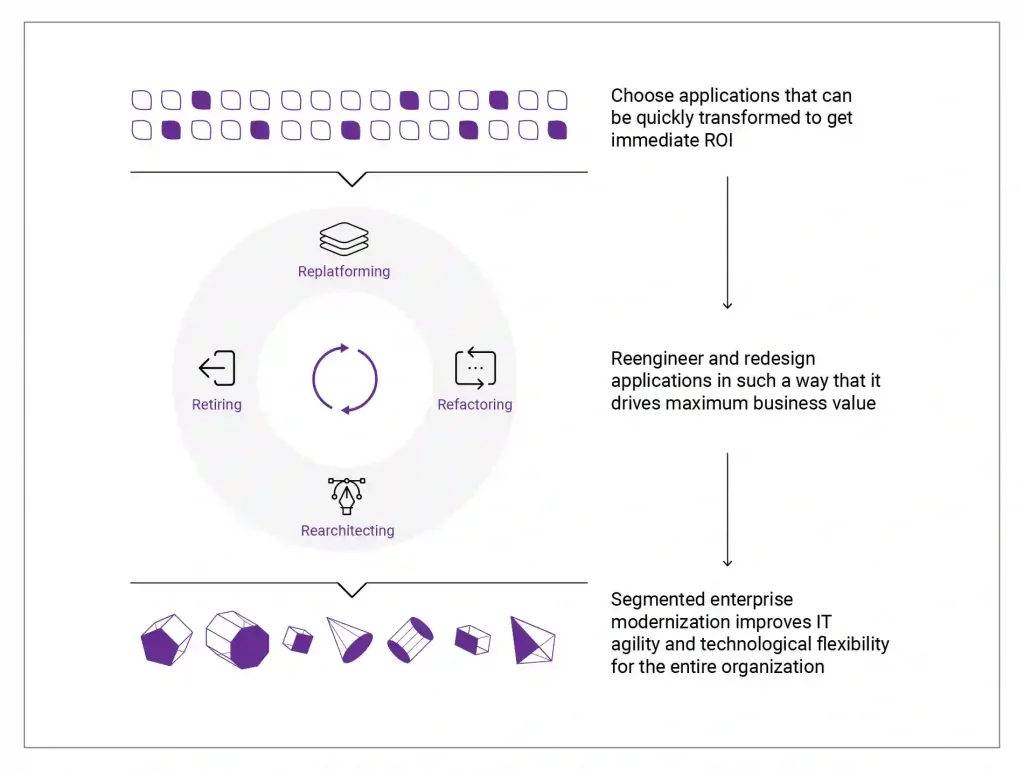
Application modernization is an approach that allows you to re-engineer a current application to attain a cloud-native architecture that best meets the organization’s existing needs. 

In most cases of application modernization, businesses fail to maintain feature parity with the older versions of the application, which prevents them from attaining optimal results. Additionally, when the process of legacy migration is not proficiently planned, businesses can miss out on the chance to eliminate features of the application that have not been frequently used in the past. This can hike up expenses and keep the application from running optimally. 

Therefore, the reengineering and redesign phases of application modernization must analyze and identify the components that are no longer required. This initiative allows organizations to create a proper plan for integrating new features while reimagining applications. 

If your organization is undergoing the application modernization process, you need to create a detailed action plan. To start, identify what your users need and compare those requirements with the business goals and metrics. Essentially, you can then implement the modernization process to ensure complete optimization in your business practices. 

That said, legacy modernization emphasizes a single application or specifically clarified applications. The process can be implemented in one of four ways:

Replatforming

Legacy modernization also includes re-platforming to the cloud. With this approach, minimal changes are implemented to ensure that the program can run in the cloud. For instance, re-platforming can be the ideal choice for businesses that can optimize their operation by using a cloud-based deployment model. However, re-platforming would become essential if the firm’s existing software lacks the required architecture that enables cloud compatibility. 

Refactoring

Refactoring occurs when the business requires product evolution, but its current application needs restructuring to cater to that request. For instance, your business can go for refactoring if you wish to add an API layer to a legacy application to reveal its core assets. 

Rearchitecting

If you have a high-value legacy application that experiences fluctuations, re-architecting it would be the right thing to do. This process ensures that the application undergoes a cloud-native rewrite, which further paves the way for product evolution and new feature development. 

Additionally, you can also take on this approach to disengage the core business capabilities to optimize application stability. Or you could use it to move to cohesive, protractile application architecture.

Retiring

Software applications, or their feature sets, are retired with the objective to cut down application complexity, identify technical perforations, and eliminate any component that does not offer value to the business or its application.

Application Modernization

Why is Application Modernization Ideal for Low-Budget Businesses?

Implementing application modernization is ideal for businesses looking for a cost-effective solution. The process can be segmented to provide partial modernization that creates a foundation for a broader, enterprise-wide modernization that you can execute in the long run. 

All in all, modernization on a small scale sets a stepping stone for full-scale legacy modernization. By starting small, you can make the necessary improvements in the workflow in a unified application and continue to bring value to your business.

When you are initiating your modernization strategy, you can: 

  • Try out different approaches and features without investing a large number of resources
  • Assess the results of modernization by examining the positive outcome following its implementation. This can encourage your business to plan for long-term modernization 
  • Add efficiency to operations that require the most updates. It can help improve responsiveness, agility, and speed in your organization’s applications 

Benefits of Application Modernization

Legacy modernization provides businesses with several advantages. Let’s look at how your organization can benefit from this approach:

More Effective IT Agility

Research shows that 76% of organizations with successful modernization saw improvements in IT agility. Undergoing this process also empowered businesses to reduce their time-to-market by 10.3%.  

That said, implementing modernization further assists businesses in increasing developer efficiency. This is because the applications are liberated from legacy monoliths, and the application is shifted or re-architectured to a new cloud platform. This process streamlines the process for further development. 

Essentially, when applications are detached from legacy interdependencies and are moved to a flexible cloud platform, your developers can use advanced tools and practices to improve the associated workflows. As a result, developer efficiency is guaranteed. 

Implementing this process also allows your team to experiment better and create new integration much faster. You can also remove or upload applications without any hindrances and minimize the application’s time-to-market. 

Improved Flexibility

Since the process decreases the time to market, you can add agility to your business model. Moreover, the application modernization process has a segmented nature, which makes it easier for your developers to make the necessary changes. 

As a result, you can easily cater to the changes in the market by swiftly adjusting your services instantly. For instance, if a customer demand or market force fluctuates, your business can stay ahead with legacy modernization. 

Additionally, you can also make use of a development process for these applications, which can assist in identifying various ideas, including the likes of continuous delivery and platform thinking. Finally, you can defend the need for an all-enterprise modernization using these outcomes. 

Inviting Talented Resources 

Undergoing the process of application modernization can equip your team with experienced and talented resources. This is because in-demand engineers and developers gravitate towards organizations that streamline their operations and use their expertise to refine work processes using cloud tools and cloud-native methods. Additionally, the process builds your organization’s reputation and helps you train recruits more effectively. 

How to Effectively Carry Out Application Modernization

App modernization needs to be thoroughly planned to provide benefits to your organization. Let’s explore a few ways you can plan this process:

Identify Apps With High ROI 

It is essential for businesses with a limited budget to create a quick returns strategy. This is why you need to identify the applications that yield a high ROI after they are modernized. With this approach, you can explore the following: 

  • Your business’s foundational capability?
  • The technical criteria. This may include legacy applications, the complexity of code, code hygiene, cost optimization opportunities, and coupling

You can then amalgamate the preceding information to create a foundation for your modernization approach. 

Identify Your Business Needs

Essentially, application modernization must serve a purpose. This is why it is imperative to identify and write down your business’s short and long-term needs. This step will help you create objectives for modernization, which will influence the refactoring, re-architecturing, and re-platforming stages. 

Pave the way for Future Modernization

Application modernization should be an ever-changing process. Therefore, you need to create a plan that allows your business applications the flexibility to evolve with the market’s fluctuating needs over time. Consequently, you must consider the evolutionary architecture methods, platform thinking and plan deep continuous delivery to ensure your business remains ahead in digital advancement. 

The Bottom Line

The current digital atmosphere has made it imperative for businesses to integrate the latest technology to improve operations and delivery. Your organization can reap several advantages from undergoing application modernization. However, it is essential to make sure that you start the process by prioritizing high returns at the initial stage.

This will give you more reasons to implement future modernization. In addition, creating a strategic approach to modernization will certify that your engineering team includes talented resources, which can quickly perfect the applications over time. Finally, undergoing calculated modernization will enable you to maximize value from cloud migration, benefit from a high ROI, and collaborate with a cloud-native firm. 


Nexus logo

Get Started with NexUs Today!

NexAssure logo

Get Started with NexAssure Today!

NexDox logo

Get Started with NexDox Today!

NexOps logo

Get Started with NexOps Today!

NexAA logo

Get Started with NexAA Today!

logo

Let's talk about your next big project.

Looking for a new career?