📢 TVS Next partners with Snowflake to redefine Data and AI outcomes.

Category Archive

Data and AI

5 Best Practices to Drive Seamless Cloud Migration

Alex Thompson Data and AI August 26, 2021

With most organizations unexpectedly thrust into the remote work scene all of a sudden, the popularity of cloud environments has been at an all-time high. While cloud enables an anywhere and anytime kind of access, allowing businesses to function efficiently even in the post-pandemic era, it has also helped businesses see other upsides to it: cost and process streamlining to name a few.

Migrating an entire organization’s data to the cloud is not an easy task. Despite careful considerations and strategic planning initiatives, leaders often are blindsided by unexpected pitfalls that affect their overall business.

Here are 5 best practices to ensure your cloud migration happens without any unforeseen complications.

Plan, plan and plan some more

Of course, no organization would embark on a cloud migration journey without planning its budget. But what companies often fail to account for is their future needs, the maintenance costs for the infrastructure, application modernization requirements, and the price variations between different cloud environments. When they’re hit with sudden costs that they previously thought didn’t exist, organizations hit a roadblock.

It is therefore very important to figure out which cloud solution—public, private, hybrid and multi-cloud—suits your organizational needs and meets your budget.

The road not taken might be your right approach

Your organization is unique and therefore your migration strategy must also be unique. Simply “lifting and shifting” data is not what cloud migration is about. Many on-premise applications might not function efficiently after rehosting. This might become a huge bottleneck, especially when major departments are dependent on malfunctioning applications. No organization wants to deal with IT downtimes, especially after they’ve migrated to the cloud. This will also strain the budget when application modernization requirements arise.

Run a discovery and assessment of all the applications and plan your cloud migration approach: rehosting, re-platforming, refactoring or a mix of all these.

Teamwork makes the dreamwork

It’s common for even the technology workforce to experience digital disdain. Involve your workforce, listen to their apprehensions, provide thorough training and give them enough time to get acquainted with the new system. Involving them after the migration is entirely complete could become a very costly mistake.

This also applies if you choose to seek help from an external team for the migration. Form a team with members from both the migration partner and your workforce. Create a checklist, assign ownerships and streamline the process. Choose the right partner with proven experience in migrating for a company of your scale.

Take one safe step at a time

Another big mistake organizations tend to make is not taking it slow. Create a checklist to not miss anything and follow it strictly. Set goalsprepare for worst-case scenariosbreak the process down into stages, and start with smaller departments such as HR or marketing that have the least business impact. This will help you identify potential issues that could occur later when the important datasets are migrated.

Measure your success

Ideally, measuring your success should be your first and your last step in your migration journey. In the first step, you will create a vision of how this migration will positively impact your business and outline your expectations. Once the migration is complete, measure the performance of your applications and business units and see where you stand.

 On a side note, documenting this success could also come in handy when you have to convince your stakeholders when you embark on more technology adoption projects.

Cloud is here, and it is here to stay

And that’s a good thing because it helps organizations of all sizes to leverage the best of technologies and make their business thrive better. Now it’s up to us to take the big step.

Why It’s Vital for Companies to Focus on Data Engineering?

Alex Thompson Data and AI July 12, 2021
Why-Its-Vital-for-Companies-to-Focus-on-Data-Engineering

Digitalization is multiplying, making data the most prized asset in the world. Organizations are strategically moving towards insight-driven models where business decisions, process enhancement, and technology investments are handled with the knowledge gained from data. Big budgets are planned to make use of abundant data available, and this spending will only increase over the years. 

According to a recent IDC report, it is estimated that by 2025 the Global Datasphere will grow to 175 zettabytes (175 trillion gigabytes). It also states that 60% of this data will be created and managed by businesses, driven by Artificial Intelligence (AI), Internet of Things (IoT), and Machine Learning (ML). AI and ML are gaining mainstream focus among many industries, and global spending is expected to grow to $57.6B by 2021.

How Data Engineering is helping businesses succeed?

Organizations often consider Data Science to be the only method to gain meaningful insights necessary to drive their business goals. However, the real potential lies within Data Engineering, which allows companies to build large maintainable data reservoirs. These design data processes are scalable and ensure relevant data is available for Data Science and Data Analytics to process complex statistical programs and algorithms to provide useful results. Only with reliable and accurate insights created from diverse sources can help data analytics harness the full power of data. 

Today, AI and ML have become integral parts of organizations, helping them achieve higher operational efficiency, become agile, taper new market opportunities, launch new products with faster go-to-market, and provide higher customer satisfaction. But according to a survey done by MIT Tech Review, 48% of companies said that getting access to high quality and accurate data was the biggest obstacle in successfully implementing an AI program. To overcome this hurdle, businesses must focus on effective Data Engineering, which forms the basic building blocks for AI and ML.

Three advantages of effective Data Engineering:

1) Accelerates Data Science 

2) Removes bottlenecks from Data Infrastructure 

3) Democratizes data for Data Scientists and Data Analytics 

Once organizations understand and internalize this, it is easy to see how the potential of Data Engineering is limitless. 
Data-Engineering

How data engineering is helping businesses across industries

Industry influencers and other prominent stakeholders certainly agree that Data Engineering has become a big game-changer in most, if not all, types of modern industries over the last few years. As Data Engineering continues to permeate our day-to-day lives, there has been a significant shift from the hype surrounding it to finding real value in its use. 

Manufacturing

Industry 4.0 is here, and the sooner organizations start their digital transformation, the better equipped they become to handle the evolving market conditions. What Industry 4.0 has brought is a significant shift in how manufacturing businesses are changing from being purely process-driven, to becoming data-driven. This essentially means that companies are either adding new digital components or updating their existing components with digital features. However, this creates a complex technology landscape where legacy systems have to interact with modern systems. 

An effective Data Engineering solution can communicate and retrieve data from different systems, sort out critical data from a pool of data, and process them to be analyzed further. Data Engineering bridges the gap between Production, Research Development, Maintenance, and Data Science. Data Engineering can help in enhancing the critical aspects of manufacturing industry—production optimization, quality assurance, preventive maintenance, effective utilization of resources, and, ultimately, cost reduction. 

Entertainment

Data has the power to make or break a business, and no one understands this better than Netflix. The incredibly successful data-driven company uses insights across its business functions to decide what new content to invest in and launch, enhance operational efficiency, and, most importantly, provide predictive recommendations for its global audience. 

Netflix has also used its robust Data Engineering system to convert over 700 billion raw events into business insights, which is one primary reason why the company continues to be the market leader.

Retail

The retail industry is continuously trying to tap into new business opportunities by gaining insights from data sources across the physical and virtual ecosystems. To gain these business insights, data must be gathered from a large network (comprising of POS systems, e-commerce platforms, social media, mobile apps, supply chain systems, vendor management systems, inventory management systems, in-store sensors, cameras, and a growing list of new sources). 

An effective Data Engineering solution can bring together massive sets of structured and unstructured data from entire value chain to provide trends, patterns, customer insights, and more. A retailer with stores across the globe and an omnichannel presence can harness data sources in innovative ways with Data Engineering to gain a detailed understanding of the market, the competition, and every step of the customer journey. 

Healthcare

Leading healthcare giants are progressively investing in integrating ML into their core functions. However, they are focusing on setting up their data infrastructure by building Data Engineering platforms. The healthcare industry is looking to unlock value from data to gain knowledge into the patient, healthcare worker, and the healthcare system on a large scale. 

Data Engineering brings together insights from electronic patient records and hospital data, as well as new advanced data sources like gene sequencing, sensors, and wearables. It offers them to Data Analytics to provide better medical treatment. 

How Data Engineering is fueling the businesses of the future

To manage data at large scale and segregate business-critical data from the rest, organizations need a long-term data strategy plan to be future-ready with Data Engineering as critical approach. 

Data Engineering creates scalable data pipelines

Distributed data processing systems can help create reliable data pipelines with low level of network management to meet huge volumes and tap into increasing data sources in a growing ecosystem of touchpoints. 

Data Engineering ensures that data is consistent, reliable, and reproducible

For data processing to be successful through the stages of ingestion, analytics, and insights, it is important that the data be compatible by ensuring it complies with the required formats and specifications. Data science can derive better insights from data by providing reliable and reproducible data.

Data Engineering helps ensure that processing latency is low

Most essential business insights are required to be in real-time to have an effective impact, be it with customer experience in the retail industry or predictive analysis in the financial sector. If the data being analyzed has a significant time delay, the insights can be less effective or completely ineffective. 

Data Engineering optimizes infrastructure usage and computing resources

Using the right algorithm for data engineering can save a considerable amount of money spent on resources. This can provide significant savings to organizations and help them optimally utilize their technology landscape. 

Businesses must design Data Engineering solutions that are unique to their needs and create customized frameworks rather than follow trends. At the same time, many new start-ups begin their data journeys with clearly defined data sets. In contrast, traditional organizations may have larger ones from legacy systems and data sets from new sources. It is important to understand that while the Data Engineering tools for a particular organization are zeroed, no general rule can be used. Only a comprehensive study of a company’s unique technology ecosystem and business needs can determine the type of Data Engineering systems that should be used. 

Data Engineering solutions must also be flexible. How data is produced and consumed is constantly evolving, so Data Engineering solutions or frameworks must be flexible to accommodate future requirements. Guiding the movement in this direction is the shift from traditional Extract Transform and Load (ETL) methods of the data pipeline to more pliable patterns like ingesting, model, enhance, transform, and deliver. The latter provides more flexibility by decoupling Data Pipeline services. 

Many experts focus on Data Engineering one step further by encouraging companies to adopt a Data Engineering Culture. This permanently recognizes the need for Data Engineering at all levels of an organization across functions and warns that business predictions will fail without effective Data Engineering and an appropriate ratio of Data Engineers to Data Scientists. 

The sooner organizations push for Data Engineering Culture and create organizational alignment, the more equipped they will be for the future, to which data holds the key. 

How TVS Next created a Data Engineering solution for one of India’s top utility companies

In the energy sector, large enterprises are turning real-time data to drive effective energy management. Energy corporations rely on data for efficient resource management, operational optimization, reduced costs, and increased customer satisfaction with better insights into supply and demand in real-time. 

TVS Next helped one of India’s leading utility companies build a distributed computing engine for processing and querying data at scale. The solution provided the company with tools to visualize key performance indicators using real-time data. With effective Data Engineering, the client improved the customer experience rather than relying on complex algorithms to predict outcomes. 

What are some of the achievements and challenges you have faced while planning a Data Engineering system for your organization? Share your story and get in touch with us here


Improve Retail Business With Machine Learning

Alex Thompson Data and AI October 22, 2020
Improve-Retail-Business-With-Machine-Learning

Technology has transformed how customers and brands communicate with each other. Shoppers were once dependent on face-to-face, in-store interactions to make purchases and receive support. Now, shoppers do their research before entering a store (81 percent of shoppers conduct online research before buying) and hardly rely on salespersons to help them make decisions. Retailers, however, have understood that by embracing technology, they can extend their storefronts to their customers’ fingertips.

Shoppers can make purchases from within social media apps and compare prices without leaving a store. While these technologies have propelled the retail industry further into the digital age, the technology that is still evolving will have the largest impact on the future of the customer service and retail industries.

Embracing Big Data

More retailers are tracking customer shopping habits through data sources such as social media, purchase history, consumer demand, and market trends. By relying on big data technology to gain a deep understanding of shoppers and their buying trends, retailers can maximize customers’ spending and encourage customer loyalty.

According to research by Accenture report, 70 percent said that big data is necessary to maintain competitiveness, and 82 percent agreed that big data is changing how they interact with and relate to customers.

Matching Products with People

Machine learning technology boosts the reach of big data analytics and can help create an exceptional shopping experience. Innovative retailers can tap into the power of machine learning algorithms to do things like determine available products from outside vendors or recommend the quantity, price, shelf placement, and marketing channel that would reach the right customer in a particular area.

Further, the capability to automate everything through advanced analytics and machine learning soon will mean that basic customer service will be performed by bots that can predict our needs and provide service in the fastest, most immediate way possible: by offering us items we didn’t know we needed. As retailers gain more insight into their customers and products, machine learning will be able to match buyers and sellers based on buyers’ needs and product availability.

Digital Assistants

Shopping is becoming increasingly programmatic. In the future, services like digital assistants (Siri, Cortana, etc.,) will learn more about us and offer us relevant and personalized product offers. Say, for example, you use a particular brand of perfume. Your digital assistant will learn your shopping and usage habits and offer you the best deal on the product at the right time. It might even place the order for you.

Improving the backend

Machine learning and advanced analytics will not only change how we shop and provide customer service, but also simplify how retailers perform basic operations. Data science and machine learning give us the ability to automate so much of the heavy lifting required to find insight within a pile of data. With these tools, retailers can find useable and useful data to change the shopping experience for consumers.

Technology enables us to create an index of every product in the world, enabling retailers to offer customers the best prices, keep products adequately stocked, and track competitors’ minimum-advertised-price violations. A central database of the world’s product information enables retailers to offer the best shopping experience for buyers.

An innovative-technology approach to customer service and commerce will combine data about our behaviors and choices with data about products and product attributes to create the best shopping experience. This approach takes the guesswork out of purchasing and makes the shopping experience more cherishable for everyone.

Top 5 Big Data Trends In 2020

Alex Thompson Data and AI October 21, 2020
Big Data Trends

When the world big data rapidly expanded a decade ago, there were no signs that they would slow down. It is primarily aggregated across the internet, such as social networking, web search requests, text, and media files. IoT devices and sensors produce another gigantic share of data. These are the main reasons for the global big data market growth of 49 billion dollars.

Spark will Widespread

Apache Spark is a platform for data processing that can easily perform tasks on very large data sets and also spread the functions of data processing over many devices, either on its own or in combination with other distributed computing resources. These two qualities are important to the worlds of big data and machine learning that require vast data stores to sharpen the masses of computer power. Spark removes some of the programming burdens from developers with an easy-to-use API which sums up many of the grunt tasks of distributed computing and big data processing.

Apache Spark has been one of the main computing frameworks that spread throughout the world. Spark offers native binding for Java, Scala, Python, and R languages, and supports SQLs, data sharing, machine learning, and graphic processing. The Spark software can be used in several ways.

The convergence of IoT, Cloud, and Big Data

In order to facilitate interaction between machines and humans (M2H) and machines (M2 M), the Internet of Things is an opportunity for simplifying operations in many areas. Until now it has been greatly improved. In most cases, sensor-generated data is transmitted for analysis to the Big Data System and final reports are made. This is also the main interconnecting point of the two technologies.

For the next ten years, IoT is expecting a future of $19 trillion in the web industry, which will give room for more IoT and Big Data research and development.

Cloud computing plays a significant part in the storage and management of the data by generating an immense amount of data. It is not only about big data growth but also the development of platforms such as Hadoop for data analytics. As a consequence, it provides new cloud computing opportunities. Therefore, service providers like AWS, Google, and Microsoft have cost-effectively their own Big Data Solutions for businesses of all sizes.

Mixed Reality will improve Data Visualization

AR and VR have gained a lot of traction among customers in the past few years. With the launch of Pokémon Go, Augmented Reality had garnered around 100 million users within just a few weeks of launch. Though AR or VR might not be very useful for large corporations, the concept of Mixed Reality might very well be. Mixed reality combines the virtual world with our real-world and devices like Microsoft Hololens are already gaining traction. Mixed Reality will offer huge opportunities for organizations to better perform tasks and also to better understand the big data.

Deep Learning

Deep learning is an advanced form of machine learning which is based on neural networking. Deep learning help recognize specific items of interest from massive volumes of unstructured data. It is mostly useful for learning from huge volumes of structured and unstructured data. Thus businesses and organizations should pay more attention to deep learning algorithms to deal with the heavy influx of big data.

Data Virtualization

Data virtualization will see strong momentum this year. Data virtualization has the ability to unlock the hidden concepts and conclusions from a large set of data. It also allows enterprises and organizations to retrieve and manipulate data on the go.

To address big data problems, the management and use of computer and data-intensive systems require huge amounts of highly distributed datagrams. Virtualization offers the additional flexibility needed to realize large data platforms. Although virtualization is theoretically no prerequisite for big data analysis, in a virtualized environment software frameworks are more effective.

Conclusion 

As mentioned earlier, this year will be an exciting year for big data, and analytics systems will become the top priority for organizations. These systems are expected to perform well operationally, and fulfill promises of business value to the organization.

Extracting Acronyms through Natural Language Processing

Alex Thompson Data and AI October 21, 2020
Extracting-Acronyms-through-Natural-Language-Processing

Introduction  

An acronym is a pronounceable word created from the first letter of each word in a phrase or title. An acronym is a kind of abbreviation consisting of a first letter or initial letters in a word. It’s also called short descriptors of phrase.  

Interesting Fact: Acronym was introduced as a modern linguistic element of English during the 1950s. Because acronym is called a term, its meaning is called expansion.  

Usage & Challenges 

An acronym is primarily used in language processing, web search, ontology mapping, question answering, text messaging, and social media sharing. Acronyms evolve each day dynamically, and finding their definition/expansion becomes a daunting task due to its diverse characteristics. Several researchers experimented with plain text and network expansion pairs for mining acronyms over the past two decades. Manually edited online archives have pairs of acronyms, but regularly reviewing all possible meanings is intimidating.  

Solution 

To handle this issue, TVS Next has built a specialized product to extract acronyms from a document in a few seconds. This product is built on Python for Natural Language Processing.  

Below are some pointers that describe how our research works that help us solve the problem mentioned above.   

Heuristics Approach 

NLP (Natural Language Processing) and pattern-based methods include heuristics. 

  • The NLP-based approach uses a fuzzy-matching Statistical Model based on the principles of Levenshtein’s Distance algorithm.  
  • The pattern-based approach uses custom rules that work with data from multiple domains, combined with Statistical Modelling to extract the Acronyms and their Expansions. These methods are written after considering features in the text as characteristics of acronyms – ambiguity, nesting, uppercase letters, length, and para-linguistic markers.  

An Acronym Finding Program (AFP) is a simple, free-text expansion recognition method. This program applies an inexact matching algorithm for mining AE pairs. A tool known as Three Letter Acronym (TLA) uses para-linguistic markers such as parenthesis, commas, and periods to derive acronym meaning from technical and government documents.  

Developing the Product  

A Statistical model has created to provide the user with a Solution that gives ease of access to acronyms that appear throughout the document. The designed solution can be integrated into various tools and technologies that deal with text-based information. The solution proves to be useful while combining it with tools that parse PDF documents. It deals with – tables, free-flowing text.  

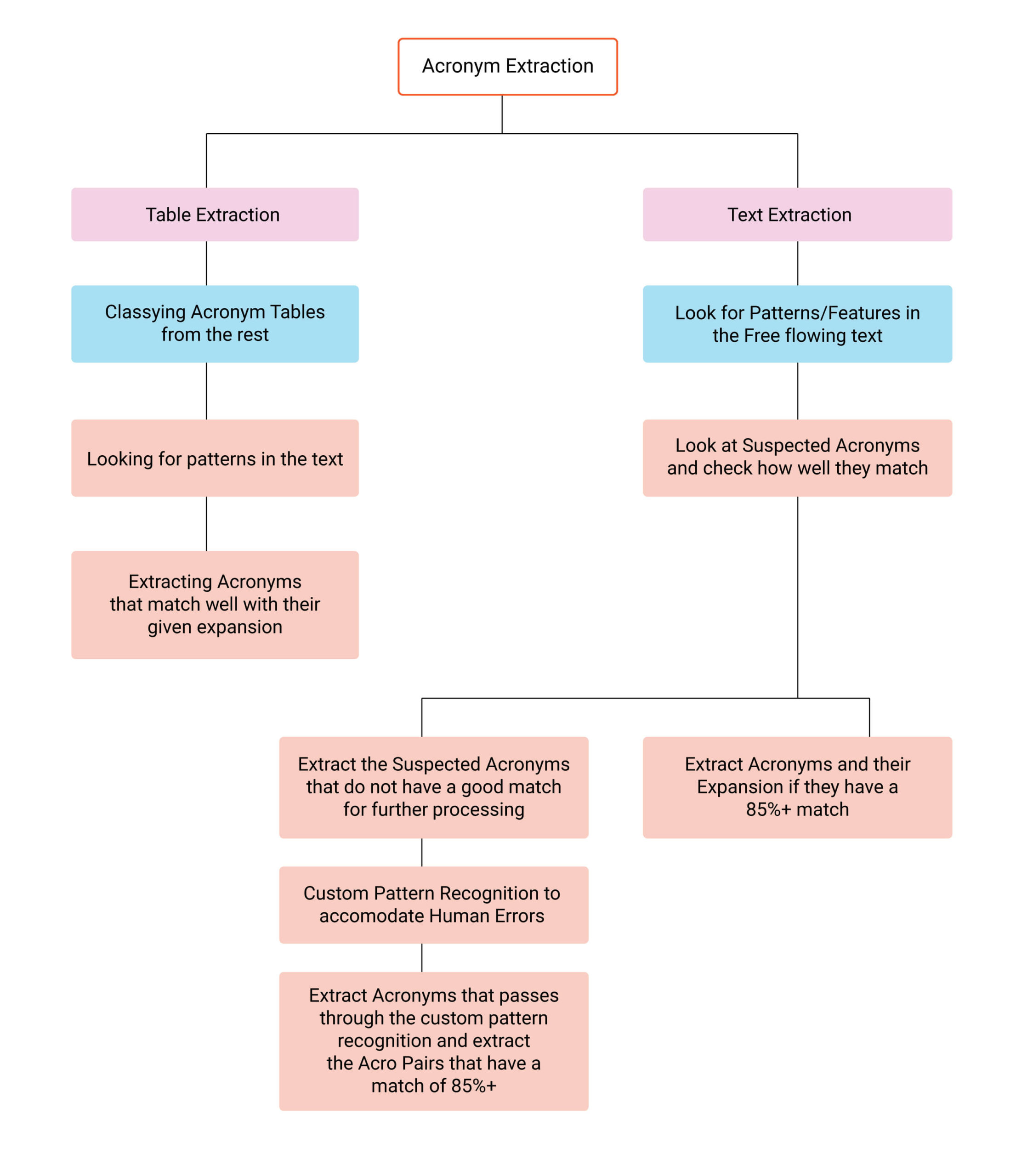
A document consists of multiple tables that are very similar in structure; hence our solution uses a Table Classification method to differentiate the acronym table from the rest. Various types of Statistical Methods were incorporated to quantify features/patterns that help define what an acronym will look like. This solution was used to classify an acronym table from the rest and then extract acronyms from the table.   

For free-flowing text, a similar technique has been used where the patterns/features of an acronym are incorporated to differentiate it from the rest of the free-flowing text. There are words extracted that can turn out to be acronyms. These words appear along with their expansion in the text. After extracting suspected acronyms, we quantify the words that consist of acronyms using statistical models and compare them to their expansions.  

By enforcing the following statistical models, 80% of acronyms are obtained that are present in a document. It is essential to accommodate variations in how text is written. Simple human punctuation errors can affect the entire acronym, not falling under rules of how acronyms are generally written. A dynamic method where custom rules that works with data from multiple domains are combined along with specific Statistical Models has been implemented that will uncommonly parse texts.  

On executing this dynamic method and testing various documents, we could conclude that the Statistical Model-based acronym extraction method has been performing with over 95% accuracy, even surpassing open source solutions provided by Spacy called Blackstone available in the market at the moment. Blackstone works on the techniques mentioned in a research paper written by Ariel S Schwartz et al. [2]., Multiple comparisons were made, between Blackstone and the Statistical-method based Acronym Extraction.

Result  

The Statistical Model-based acronym extraction method scanned an entire document of 100+ pages in milliseconds and displayed 98% accuracy. The average time taken to scan a document is a few seconds, and the accuracy of this product has been achieved between 94-98%. The product was tested on documents belonging to various domains, and it still yielded similar results. The product is developed on an experimental basis, and we are set to improve its efficiency and performance each day. There is plenty of room for improvement with subject to market changes. The product experiments with a set of Statistical models and custom rules, and the team is working on dynamic changes using AI that scans documents based on results. This product proves to be useful for lengthy and complicated engineering and medical documents. This product is one of its kind, and we are proud of our development.

At TVS Next, we re-imagine, design, and develop software to enable our clients to build a better world.  

The indispensable contribution of Big Data in the Healthcare industry

Alex Thompson Data and AI October 21, 2020
The-indispensable-contribution-of-Big-Data-in-the-Healthcare-industry

Introduction 

There’s no bigger business than the business of saving lives. And there hasn’t been a more pertinent time for businesses in healthcare to think out of the box to find solutions to pressing needs. As Centers for Disease Control and Prevention (CDC) reported, in 2012, about half of all adults, nearly 117 million people, worldwide, had chronic diseases and conditions such as heart disease, stroke, cancer, Type 2 diabetes, obesity and arthritis. The need is to prioritize prevention as much as finding cures for diseases as this is the only way to check their rampant spread.
In a span of ten years, there has been a tremendous generation of data and the use of technology to analyze the same. This has given birth to a new industry. The industry of Big Data. By using Big Data effectively, healthcare businesses have found new ways of reducing the number of preventable deaths, curing disease and improving the quality of life, while cutting their business overheads and increasing profitability. Treatment modalities have transformed and that has a lot to do with the way healthcare professionals are using Big Data to make informed decisions about patient care. Now, the impetus is on understanding patient information better and quicker, to predict the onset of illnesses and to cure them in the early stages. 

The Inception 

One of the most tangible ways data has changed healthcare is in the method used to collect it. Electronic Health Records (EHR) are now a reality across most hospitals in the U.S. at a staggering 94% adoption rate and by this year, a centralized European Health Record system is likely to come into being. EHRs have eliminated the need for paperwork, reduced data duplicity and also allowed for better treatment tracking. Today, the novelty of EHRs has worn off as technology has gotten avant-garde. 

Telemedicine has been around for no less than four decades but mobile technology has changed the face of it. With video conference tools and wireless devices, remote yet personalized treatment has been made possible and this has significantly cut costs in healthcare. Patients save money on repeat visits to hospitals and doctors save on valuable time as remote treatment has made some facets of medical treatment location agnostic. Smart wearables have also made their way into the daily life of the common man and it isn’t uncommon for friends and peers to exchange personal data that is collected by means of these devices. Industry experts predict that there will soon come a time when doctors will rely on Big Data as step one in charting treatment plans. 

The very fact that some companies are looking to collect and analyze an intangible variable such as stress is a testament to difference Big Data can make. The adoption of preventive analysis, as opposed to traditional statistical analysis, is a clear sign of things to come. Prediction modeling, the basis of preventive analysis, creates a prediction algorithm or profile of an individual using techniques such as artificial intelligence to analyze data. This can lead to better and higher individual outcomes, improve the accuracy of predictive research, and lead to pharmaceuticals creating more effective drugs. 

5 ways Big Data is Changing Healthcare 

The healthcare industry is booming faster and the need to handle patient care and innovate drugs has risen synonymously. With the rise in such needs, industry adopts new technologies. One such significant shift in the future is the use of Big Data and analytics in the healthcare sector. 

Health monitoring 

Continuous body vital monitoring along with sensor data collection would allow healthcare providers to keep patients out of the hospital because they can detect possible health problems and provide treatment before the condition gets worse. 

Reduced expenses 

Insurance companies can save money by endorsing wearables and fitness trackers to ensure patients don’t waste time in hospital. This will save patient waiting times because the hospital already has enough staff and beds available as per the study. Predictive analytics also helps minimize costs by reducing hospital readmissions. 

Assisting high-risk patients 

Once all medical records are digitized, the ideal data can be obtained to recognize other patients’ patterns. This may consistently recognize patients entering hospital and recognize their medical conditions. This awareness can help improve care for these patients and provide insight into corrective steps to minimize repeated visits. 

Preventing human errors 

It has been noted several times that the doctors either administer a wrong drug or wrongly assign another medication. These errors may usually be minimized because Big Data can be used to evaluate consumer data and prescription medication. 

Healthcare developments 

Big Data will significantly support science and technology advancement. Artificial Intelligence, like IBM’s Watson, can be used to surf through multiple data in seconds to find solutions for different diseases 

The common thread that runs through the applications of Big Data is the ability to provide real-time analysis of data. When it comes to making a decision on health, time is definitely of the essence and further use of Big Data will help professionals and patients take quick calls without compromising on accuracy. 

Conclusion 

While most of the Big Data generated is not currently completely used due to limitations of the toolset and funds, it is certainly the future. Invest in the future and using Big Data Analytics as part of an emerging Healthcare Industry by finding support from an established company like ours. 

Securing patient data with Blockchain for an EDI provider

Alex Thompson Data and AI October 9, 2020
Securing-patient-data-with-blockchain

Within the Healthcare ecosystem, there are several touch points between patients’ and healthcare systems (Hospitals, Clinics, Labs, Doctors and more) where Blockchain can be implemented.

Our team was exploring blockchain for a healthcare technology provider who is innovating in the patient’s data storage space. Our client was more than happy to explore Blockchain to see how it can help, differentiate and build capabilities.

Foundation of a new healthcare IT system lies in the creation of a platform that allows interoperability, safe storage of patient data, and efficient exchange of information securely between stakeholders. Privacy of data and user-based access control is critical, this can be achieved using blockchain.

Medical data generated from a doctor’s examination note or patients wearable device or when the patient uploads his existing medical records, a digital signature is created for verification. This data is then encrypted and sent to the cloud (encrypted) storage, with a unique pointer being created in the blockchain along with the user’s unique ID.

When a patient’s data is requested, the unique pointer on the blockchain is used to retrieve the data from the encrypted storage. It is decrypted and displays on the relevant devices. The patient will be notified every time data is added (to the blockchain), or when a request to access data is received. Users can manage access on multiple levels of their data using their web or mobile apps. Private keys can be stored on patient’s behalf or it can be put on offline storage at the patient’s convenience.

The data of a patient is further split as private and public data to enable a wider visibility to other parties in the consortium like governments and Insurers. The public data in Client’s Datasets can be used by the government and other insurance providers to analyze and gain insights from the market.

Our client is a decentralized platform that enables secure, fast and transparent exchange and usage of medical data. We introduced utilization of blockchain technology to store patient health records and maintain a single version of the patient’s true data. It will enable different healthcare agents such as doctors, hospitals, laboratories, pharmacists, insurers, and government to request permission to access and interact with medical records. Each interaction is auditable, transparent, and secure and will be recorded as a transaction on client’s distributed ledger. Moreover, no privacy is lost in this process as every data transfer happens only with the consensus of the patient; It is built on the permission-based Hyperledger Fabric architecture which allows varying access levels; patients control who can view their records, how much they see and for what length of time.

Why did we build it on blockchain?

The healthcare industry has more data breaches than any other sector and 95% of medical institutions polled said they had been victims of a cyber attack. Medical records are being stolen and sold on darknet markets where they are 10 times more expensive than credit card data.

Sometimes the threat to your privacy isn’t outside the healthcare system, but from within it. Over a million patients’ health records attending London hospitals run by the NHS Royal Free Trust are being analyzed and mined by Google with little transparency and no option for withdrawal.

Whether the threat is from the inside or the outside, it is clear that in increasingly digitized and widespread healthcare systems there are more opportunities than ever for your records to be accessed without your permission. The patient has little autonomy to defend themselves against this and legacy healthcare systems are not properly prepared to protect patients’ data.

Advantages:

  • Data can only be accessed by the patient’s private key, even if the database is hacked, the data will be unreadable.
  • A patient will have full control over accessing their healthcare data. The patient will control who sees their data and what they see (Public data is visible to everyone; private data is a restricted data)
  • Instantaneous transfer of medical data. Every member in the distributed network of the healthcare blockchain would have the same data of the patient’s record.

Learning curve involves:

  • Patients will have to learn how to use their private key properly. They may wrongly assume these can be easily changed.
  • Stakeholders will need to learn how to use blockchain technology.
  • Legacy systems will either have to be tweaked or remade

As our journey with Blockchain begins exploring various use cases that can create more security and transparency for businesses, we look forward to empowering our clients with Blockchain in other industries.


Nexus logo

Get Started with NexUs Today!


    NexAssure logo

    Get Started with NexAssure Today!


      NexDox logo

      Get Started with NexDox Today!


        NexOps logo

        Get Started with NexOps Today!


          NexAA logo

          Get Started with NexAA Today!


            TVS Next new logo

            Let's talk about your next big project.

            Looking for a new career?